Saccadic Training (SAKA)

Indications
Clients with moderate to severe limitationsafter homonymous visual field defects, neglect,disorders to visual exploration abilities and saccadicvisual movement. These occur, among other things,after cerebral infarctions in the supply area of thearteria cerebral media or posterior.
Task
The clients look at a sun/moon (fixation point) on the horizon of a simply structured landscape. At irregular intervals, objects appear to the left or right of the fixation point, accompanied by a beep. Whenever the beep sounds, the client has to find the object with large gaze jumps and indicate by means of the arrow key, whether it is located to the left or right of the fixation point. At low difficulty levels, the horizon line helps with orientation. Optokinetic stimulation can be switched on as an additional help with neglect.
Training material
There are 34 levels with differently designed backgrounds and objects. At higher levels, the objects become smaller, the horizon line disappears, and there are additional distractions. There are three difficulty levels available. These are defined by the size of the objects (3 sizes), the contrast to the background (black or grey object) and the state of the object (static or moving).
Languages
German, English, French, Spanish, Portuguese, Italian, Greek, Swedish, Danish, Dutch, Belgian (Dutch), Russian, Polish, Czech, Slovenian, Hungarian, Latvian, Lithuanian, Chinese, Traditional Chinese, Korean, Arabic, Hebrew, Farsi
Level
34
Exploration 2 (EXO2)
Indications
The training is recommended for clients with exploration problems after homonymous visual field impairments or visual neglect and can also be used as visual-spatial attention training. It is suitable for establishing a previously acquired exploration strategy in unstructured training material.
Task
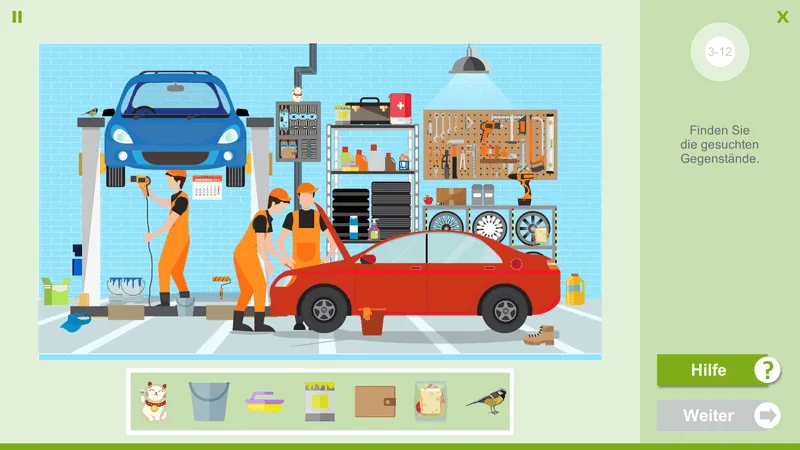
There are four different types of tasks. In the task type „Search for missing numbers“, numbers scattered on the screen should be searched in order and the missing numbers should be identified. Find Items requires finding and clicking certain items embedded in scenes. In the task type „Find and count objects“, the number of given objects must be determined. The „superimposed figures“ task is used to train detailed analysis. Simple figures are superimposed. The clients have to decide what the basic forms of the superimposed figure are.
Training material
Many detailed images and scenes are available for the tasks „Find objects“ and „Find and count objects“. The task „superimposed figures“ contains many different simple coloured or black geometric figures.
Languages
German, English, French, Spanish, Italian
Level
18
Restoration Training (RESE)
Indications
For neurologically caused visual disorders, e.g. right or left sided quadrant anopsia and the resulting perception and processing disorders. Visual restoration training requires a high training frequency and duration. At best, daily training for at least 50 - 100 sessions is recommended.
Task
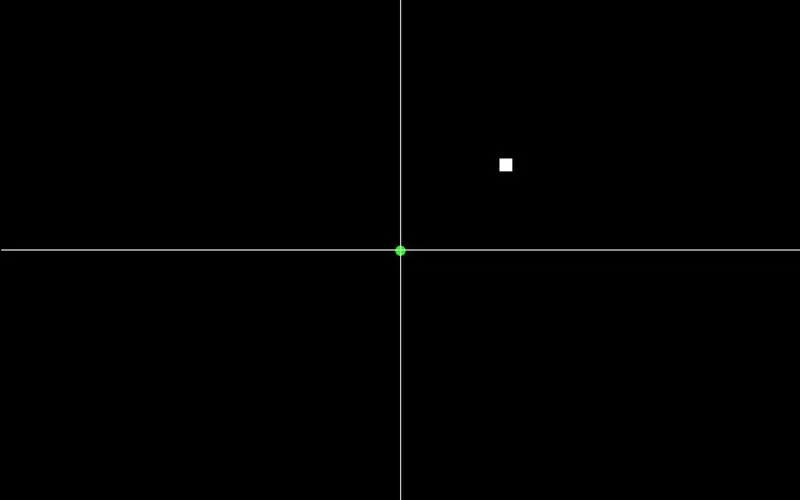
The aim of the training is to stimulate the peripheral area between the intact and impaired visual field. To do this, the clients keep their eyes on the fixation point. The light stimulus first moves from the intact visual field to the affected one until the client can no longer perceive it (limit of perception). At this point, the light stimulation lingers until the light stimulus moves one line below or above the stimulation point again from the healthy area to the perceptual border in order to stimulate here. Determining the limits of perception as well as ensuring fixation in the middle of the screen are carried out by the client pressing a button.
Training material
Stimulation takes place via moving light stimuli. Sound signals additionally help increase attention. The programme adapts to the individual ability of the clients. The use of a chin rest is recommended to stabilise the head and maintain the distance to the screen.
Languages
German, English, French, Spanish, Portuguese (partially), Italian, Swedish (partially), Danish (partially), Dutch (partially), Belgian (Dutch) (partial), Russian (partial), Polish (partial), Czech (partial), Slovenian (partial), Hungarian (partial), Latvian (partial), Lithuanian (partial), Chinese (partial), Traditional Chinese (partial), Korean, Turkish (partial), Arabic (partial), Hebrew (partial), Farsi (partial)
Level
1