Campimetry (KAMP)
Field of vision assessment
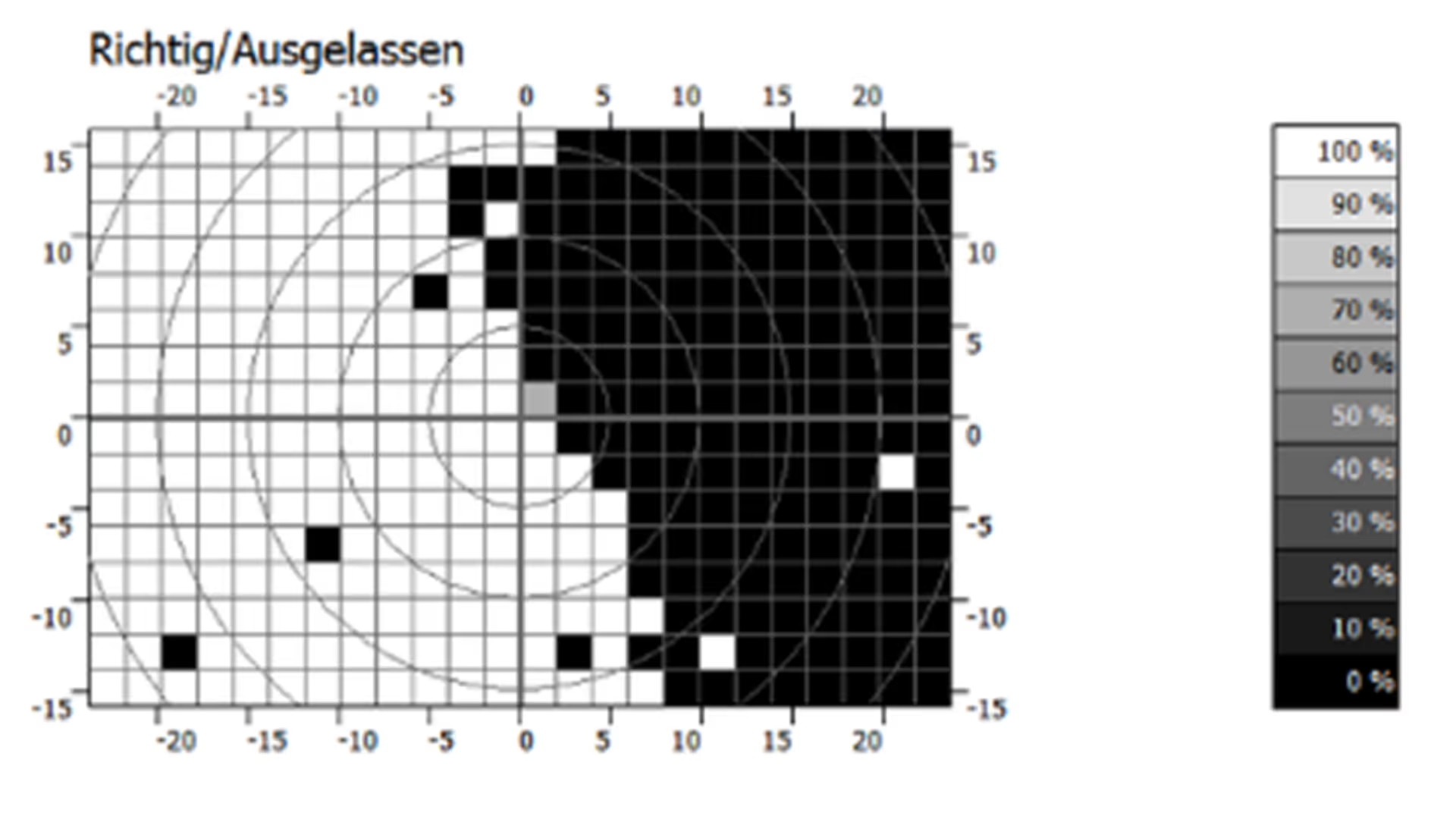
The Kampimetrie screening module can be used to test the field of vision in two dimensions, either binocularly or monocularly. During the test, stimuli appear on the screen at random intervals and in different positions. While the clients keep their gaze fixed on a central point on the screen, they should perceive these stimuli and confirm them asquickly as possible with the response button. To check fixation, the fixation point changes its colour or shape at irregular intervals. The use of a chin rest is recommended to stabilise the head and maintain the distance from the screen.
Duration
About 15 min.
Content
404 relevantstimuli, 81 fixation controls
Alertness (ALET)
Assessment of simple reaction speed as an indicatorof basal attention activation.
A stimulus is presented in the centre of the screen. The response button must be pressed as quickly as possible after each presentation. One round consists of twelve presentations. Four rounds are presented in an A-B-B-A design. In runs 2 and 3, a warning tone announces the stimulus (phasic activation). In runs 1 and 4, the stimuli appear without a warning tone (tonic arousal). In addition to the reaction times for tonic and phasic alertness, the evaluation also shows the trend in reaction times. A slowdown in reaction times can indicate fatigue and thus a decrease in tonic arousal.
Duration
5 min
Content
48 visual stimuli, of which 24 with an acoustic warning signal
Divided Attention (GEAT)
Assessment of the ability to divide attention between two channels of information.
The task is to check visual and simultaneously presented acoustic stimuli for specific stimulus conditions and to react as quickly as possible by pressing a button when they occur (dual task). While both tasks are relatively simple on their own, checking both modalities simultaneously places considerable demands on attention involvingexecutive processes. Correct and incorrect responses for both modalities are evaluated.
Duration
4 min.
Content
160 auditive Reize, 80 visuelle Reize
Selective Attention (GONT)
Assessment of selective reaction performance, i.e. the ability to respond to relevant stimuli and inhibit responses to irrelevant stimuli.
A sequence of two different stimuli is presented in quick succession in the centre of the screen. If a stimulus is relevant (GO condition), a button must be pressed. If the stimulus is not relevant (NOGO condition), the reaction impulse must be suppressed. The reaction speed and reaction control (impulse control for NOGO stimuli) are evaluated.
Duration
3–4 min.
Content
20 GO and 20 NOGO stimuli
Spatial numbers search (NUQU)
Assessment of general cognitive processing speedand lateral preference when solving a simple visualsearch task.
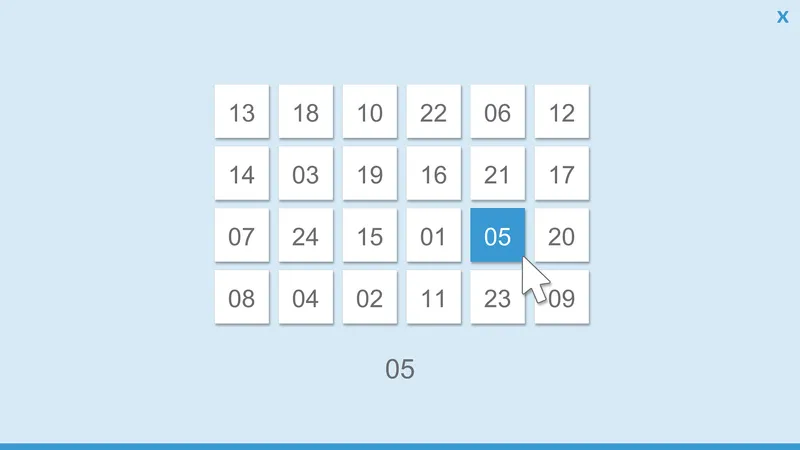
Twenty-four two-digit numbers (01-24) are presented on the screen. The task is to search for them in ascending order and click on them. Requirements are sufficient visual acuity and basic language comprehension. When entering data with the mouse, the client must be able to control the mouse reliably. The processing speed is evaluated. In addition, indicators for increased fatigue and neglect symptoms are output.
Duration
4-5 min.(max. 8 min.)
Content
24 double-digitnumbers
Working Memory (PUME)
Assessment of visual-spatial memory span
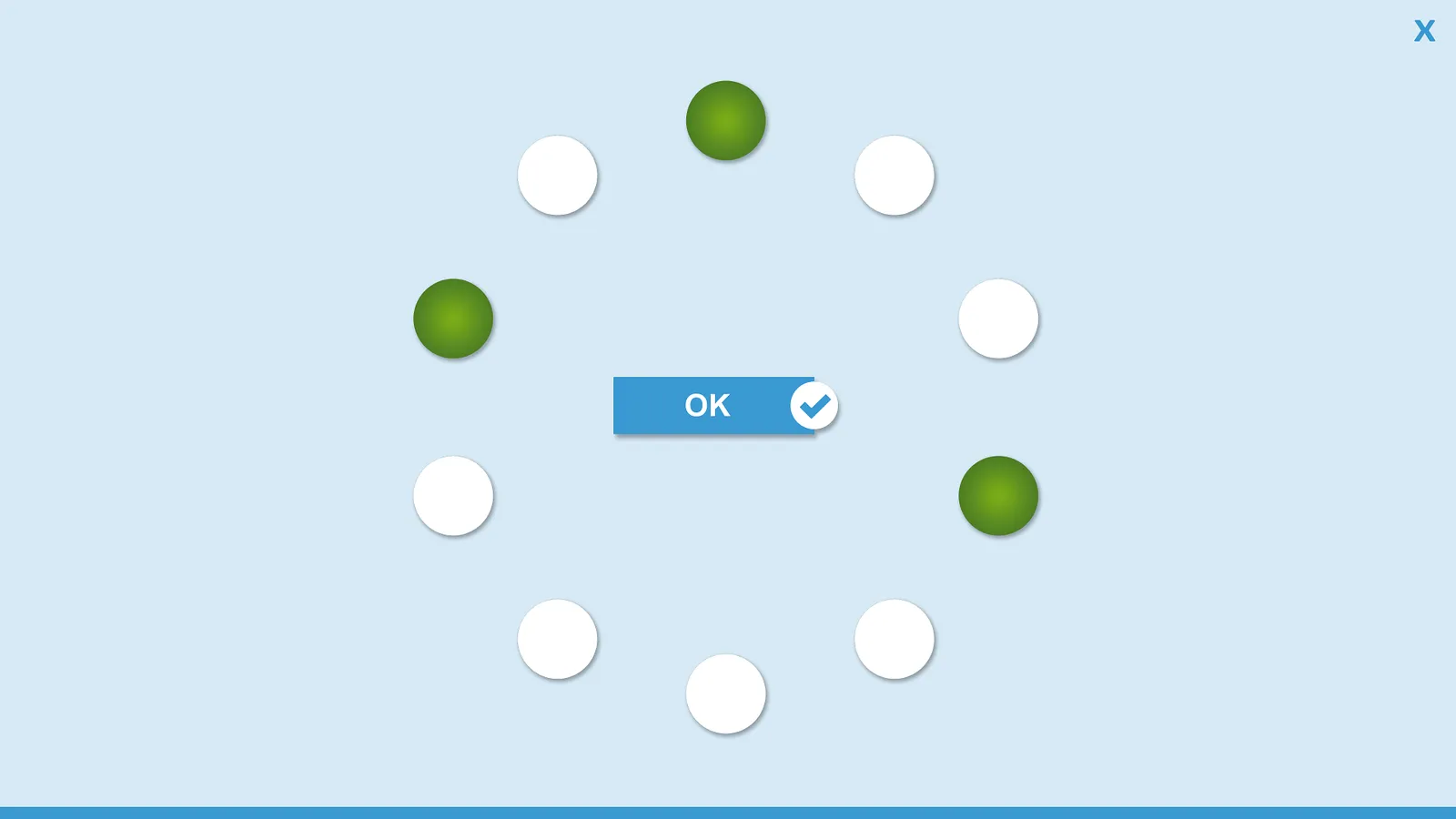
There are ten small circles arranged in a circle on the screen. During the test, these light up one after the other in different positions. The client‘s task is to memorise the order in which the circles light up and repeat it in the same order by clicking on them with the mouse or touchscreen (immediate memory span). The number of dots that light upis continuously increased. After two consecutive rounds with errors, the task is terminated.
Duration
3-7 min.
Content
10 points arranged in acircle
Memory for Words (WOMT)
Assessment of verbal learning ability (aspect ofverbal memory)
This screening module tests the ability to learnwords. Clients are shown the same twelve words infive rounds. Each time, clients must decide whetherthey have already seen the word in question or not.This is followed by five further rounds of twelvewords, in which five of the previously presentedwords are repeated. These must be identified andconfirmed by pressing a button.
Duration
10 min.
Content
72 words inblocks of 12words each
Logical Reasoning (LOGT)
Assessment of analytical and deductive reasoning.
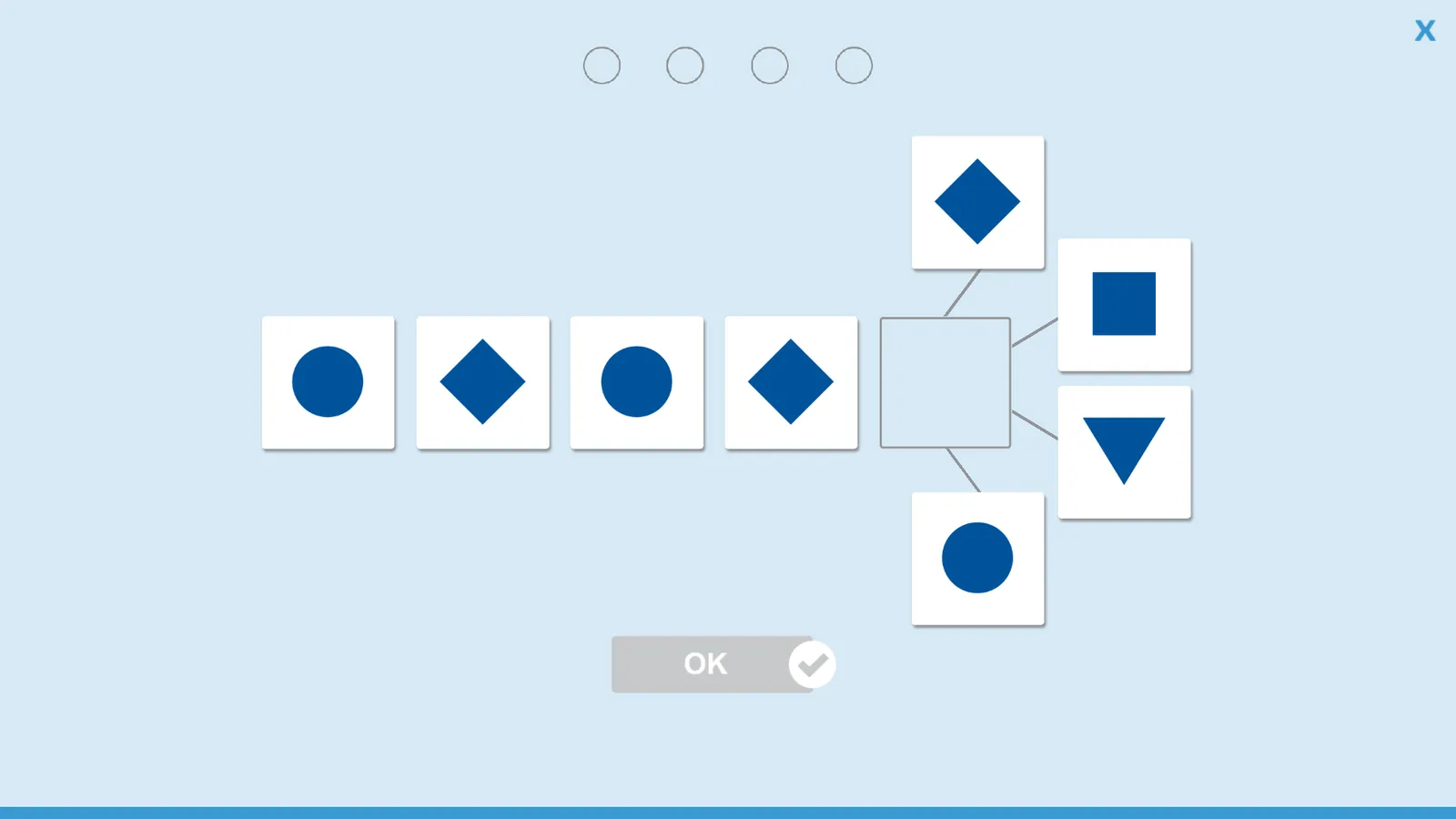
Symbols are presented on the screen that must becontinued or completed as a logical sequence. Thetask is to identify patterns, continue sequencesand draw logical conclusions. The result may revealdeficits, but does not clarify which components contributedto the performance deficit. It is advisableto additionally test working memory and attentionperformance in particular. Convergent reasoning isa prerequisite for problem solving and is a basis forperformance in executive functions.
Duration
5-7 min.(max. 13 min.)
Content
13 image sequences
Visual Field (VITE)
Measuring the visual field with requirements for selective attention
The special feature of this module is the tachistoscopic presentation of the peripheral stimulus. This allows for better control of the spontaneous exploratory movement towards the stimulus. Changes in the central stimulus at the fixation point are only clearly visible when fixation is maintained. The cognitive tasks for the fixation stimulus andthe peripheral stimulus are similar, which reduces the need for divided attention. The peripheral task requires a selective response to distinguish a target stimulus from a distracting stimulus.
Duration
ca. 10 Minuten
Content
96 relevante, 48 irrelevante Reize, 58 Fixationspunkte