Working Memory (WOME)
Verbal Memory (VERB)
Memory for Words (WORT)
Physiognomic Memory (GESI)
Memory Strategy Training (LEST)
Figural Memory (BILD)
Topological Memory (MEMO)
Working Memory (WOME)
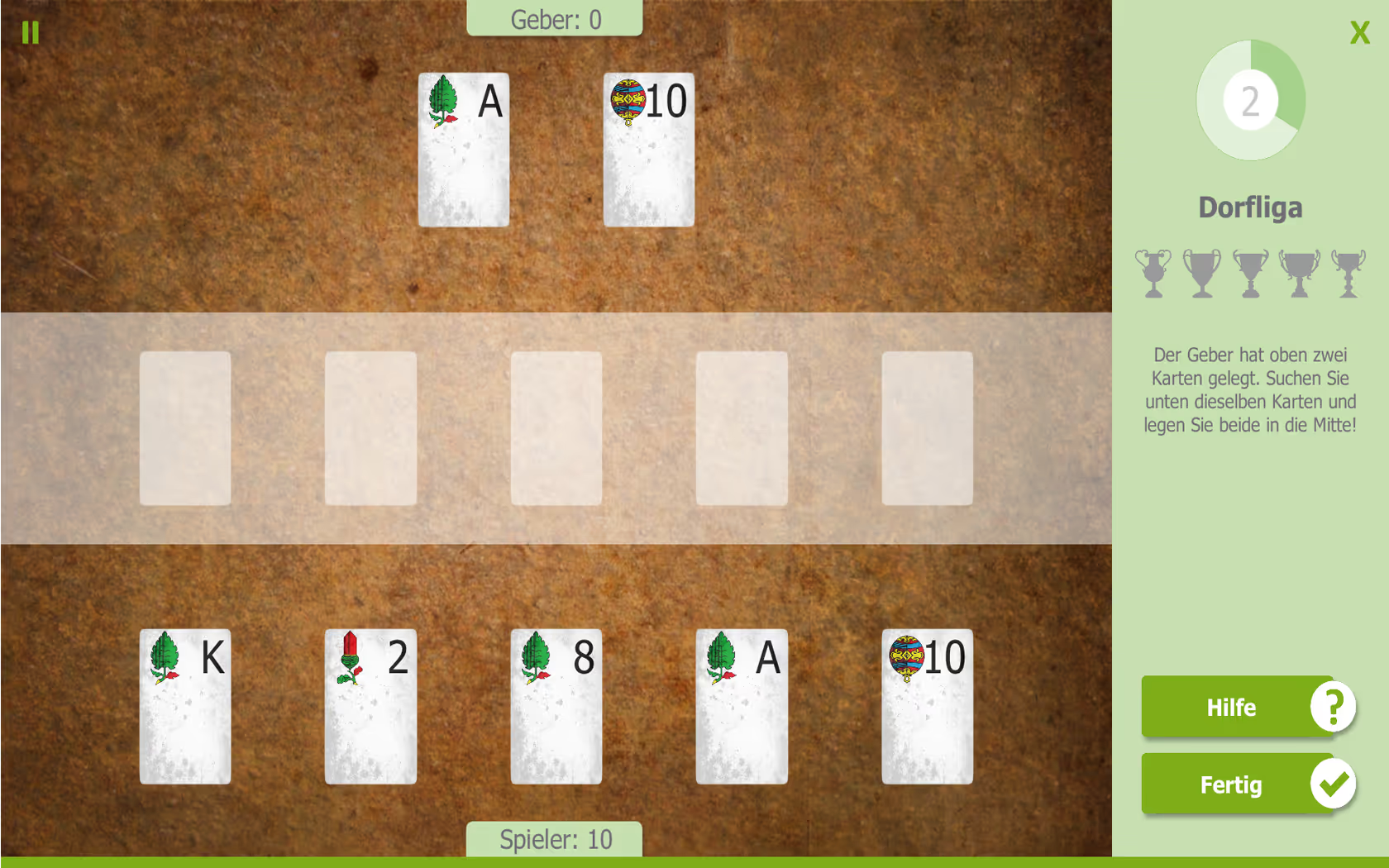
Indications
The module is suitable for clients with mild to moderate working memory disorders as a result of neurological or mental illnesses as well as for training complex attention and executive functions. Training is not recommended in cases of clear disorders of selective attention and shortterm memory.
Task
The aim is for clients to remember the other player‘s cards and place them on the table. There are various types of tasks in which either all cards need to be memorised (memory system), only certain cards (selective attention) or the clients have to work with the memorised cards mentally, e.g., lay the cards again in reverse order (central executive).
Training material
A complete deck of cards (52 cards) with French, German or coloured cards is used. The training material is supplemented by distractors on the cards, distractors for delayed recall and a reward system to support motivation. This training offers 69 levels.
Languages
German, English, French, Spanish, Portuguese (partial), Italian, Greek (partial), Swedish (partial), Finnish (partial), Danish (partial), Dutch, Belgian Dutch, Russian, Polish (partial), Czech, Slovenian (partial), Latvian (partial), Hungarian (partial), Lithuanian (partial), Chinese, Traditional Chinese, Korean, Turkish, Arabic, Hebrew, Farsi
Level
69
Verbal Memory (VERB)
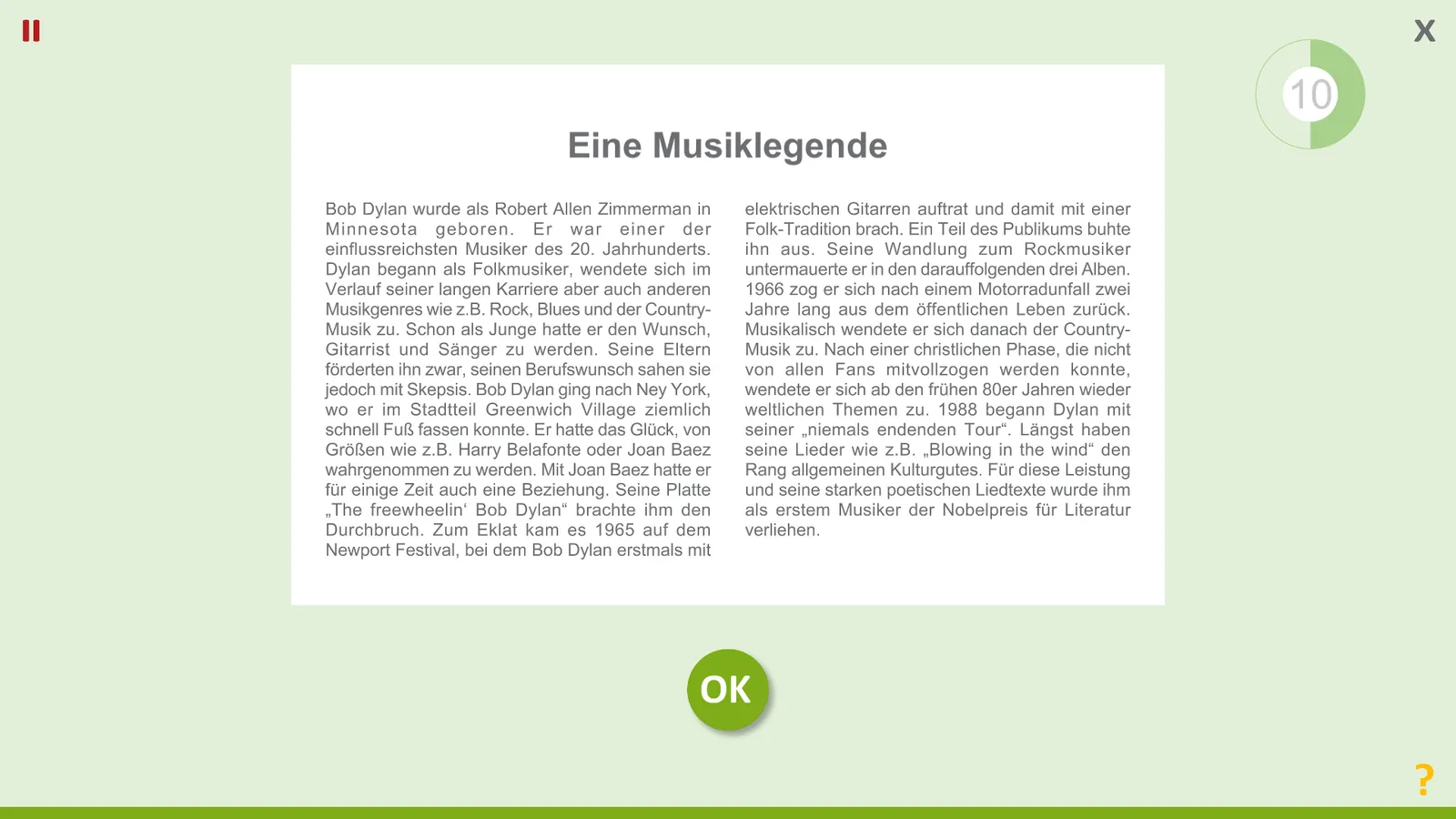
Indications
The module was made for clients with short- to medium-term verbal memory disorders. Such impairments can take place in almost all patients with brain damage (e.g., stroke, TBI, inflammatory diseases or dementias).
Task
The client has to read a short text and memorise its content (names, numbers, events). The programme offers a learning strategy for this purpose (browsing, reading, repeating). Questions are then asked about the content of the text. Depending on the option that has been selected, the questions can be answered by multiple choice or by freely entering a text. Questions related to the content of this story should then be answered.
Training material
A total of approx. 100 reading texts on different topics are available; they are assigned to ten difficulty levels. With increasing difficulty, the scope and informative content of the story as well as the number of names, numbers and events/objects queried increase. Individual texts can be created through an editor.
Languages
German, English, French, Spanish, Portuguese, Italian, Greek (partial), Swedish (partial), Danish (partial), Dutch, Belgian Dutch, Russian, Polish (partial), Czech, Slovenian, Hungarian, Latvian (partial), Lithuanian, Chinese, Traditional Chinese, Korean, Turkish (partial), Arabic, Hebrew, Farsi
Level
10
Memory for Words (WORT)
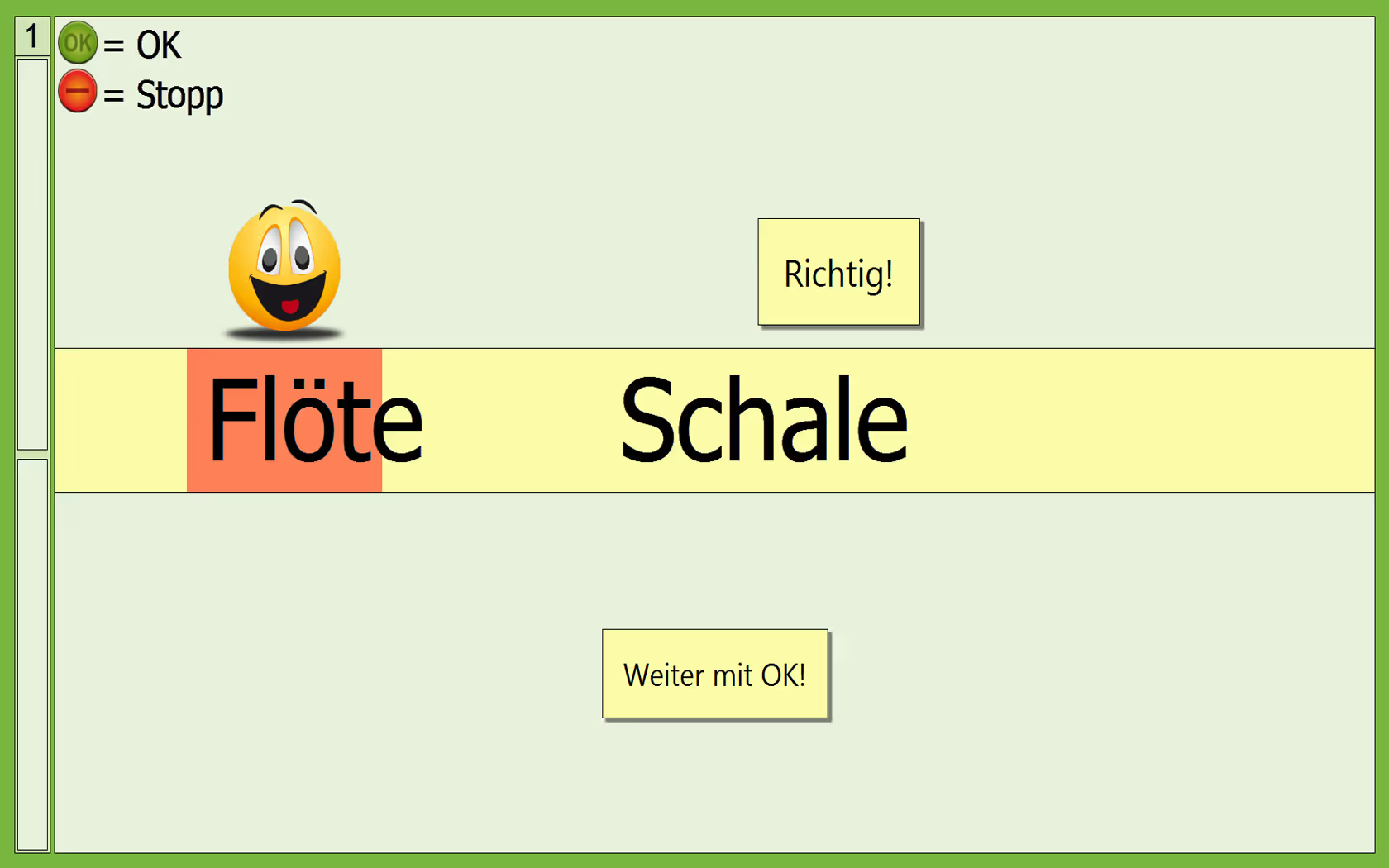
Indications
Memory disorders for verbal content after neurological diseases such as a stroke. The module is suitable for clients with impaired word span and reduced recall, especially with incipient amnestic syndrome. Other indications are verbal memory disorders due to post-acute depression or after intoxication.
Task
During the learning phase, the clients memorise a list of words (1 to max. 10 words). The difficulty level increases with the number and complexity of words. Those words that were presented in the learning phase must then be selected from a series of words not presented.
Training material
The words appear in clear and large script. The movement of the words is continuous and fluid. The speed can be adjusted. The words presented are divided into three groups of 200 words each, simple short, simple compound and complex compound.
Languages
German, English, French, Spanish, Portuguese, Italian, Greek, Swedish, Finnish, Danish, Dutch, Belgian Dutch, Russian
Level
30
Physiognomic Memory (GESI)
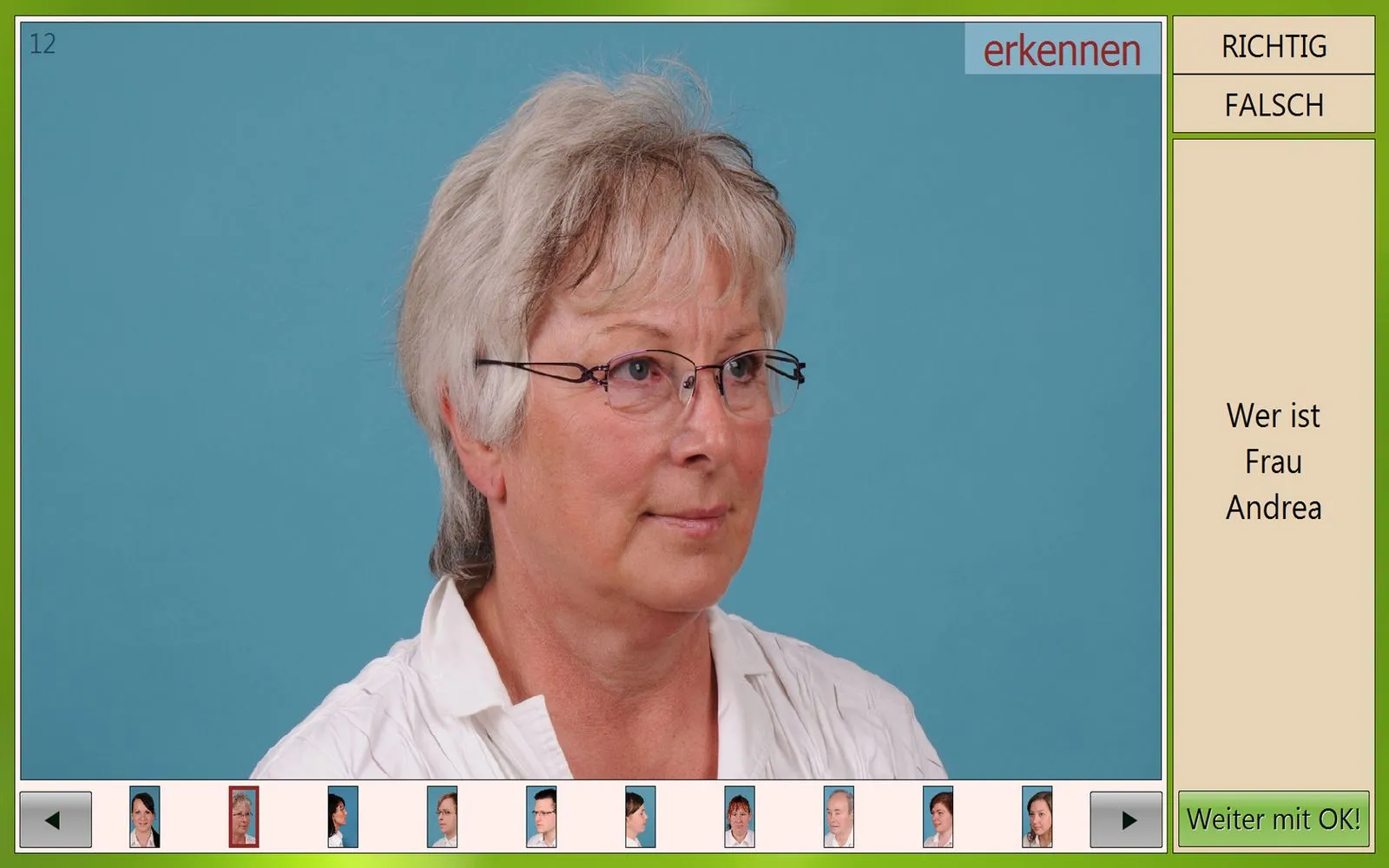
Indications
For clients who have problems in remembering faces and related information. The training is particularly suitable for clients who deal with many different people in everyday life and at work.
Task
The clients need to memorise faces in a learning phase. These faces must then be selected from a series of other faces. In higher levels, a name, later a job title and an initial 5-digit telephone number are given to the face. Afterwards, the clients have the task of finding out the face associated with a name, profession or telephone number.
Training material
47 people in total were photographed from four different perspectives. By using an editor, this training can also be carried out with individual images, e.g., from the client‘s personal surroundings. The structure is as follows: Remember faces (6 levels), remember faces with names (5 levels), remember faces associated with names, occupation and phone number (5 levels).
Languages
German, English, French, Spanish, Portuguese, Italian, Greek, Swedish, Finnish (partially), Danish, Dutch, Belgian (Dutch), Russian, Polish, Czech, Slovenian (partial), Hungarian, Latvian, Lithuanian, Chinese, Traditional Chinese, Korean, Turkish, Arabic, Hebrew, Farsi
Level
21
Memory Strategy Training (LEST)
Indications
This training is suitable for clients with mild to moderate learning disorders. Clients with linguistic or figurative learning disorders can benefit equally from the training. For rehabilitation, we recommend the C-phase and upwards.
Task
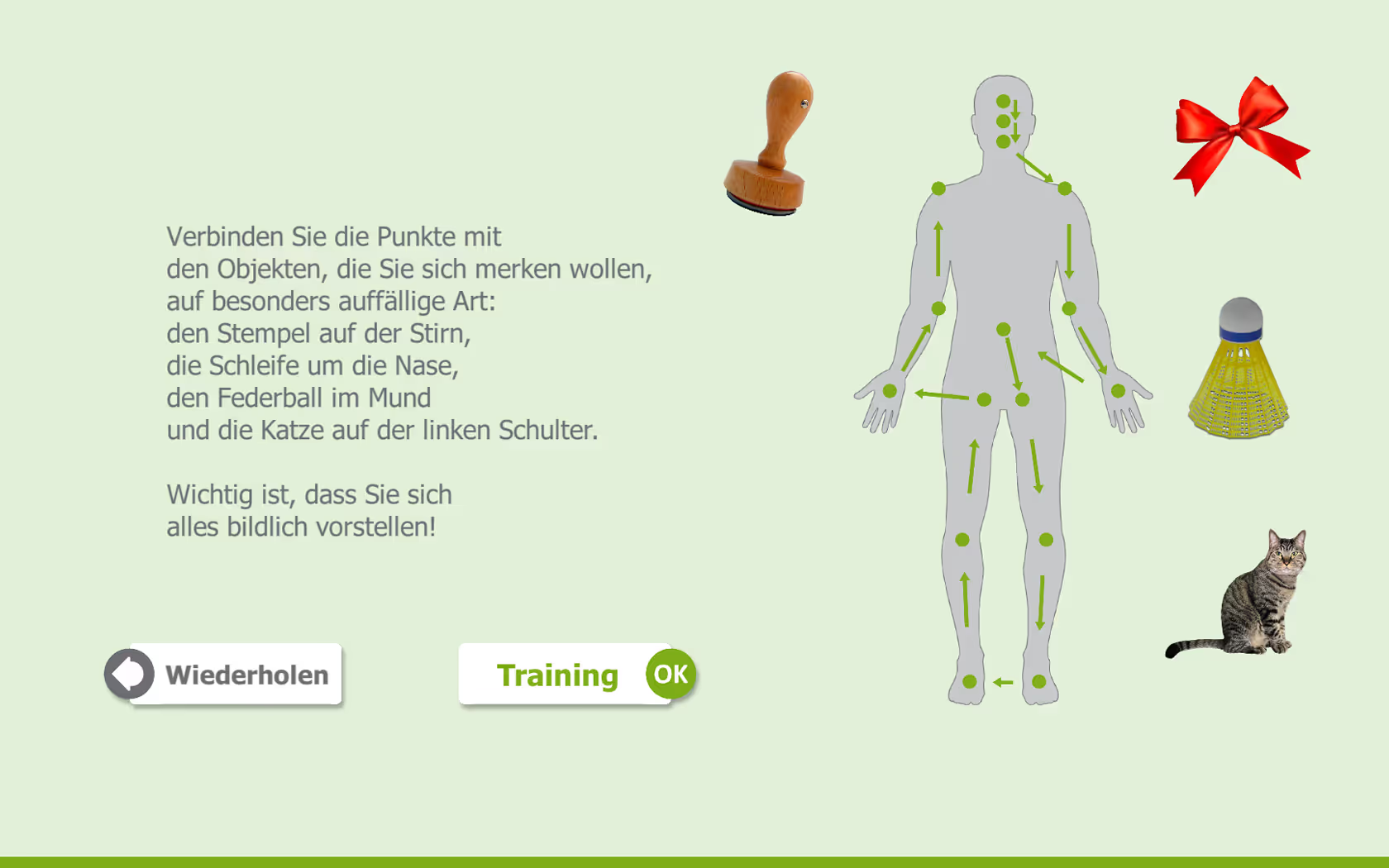
The task is to memorise the presented objects. These can optionally be presented as words or images. During the learning phase, learning strategies (e.g., figurative imagination or body route) are communicated. After a simple distraction task, the clients must recognise the objects they have learnt.
Training material
Two learning strategies are available. There are 18 levels with about 300 shown objects as high-resolution photos or words. As the degree of difficulty increases, the amount of information to be memorised and the number of deflective stimuli during recognition increases.
Languages
German, English, French, Spanish, Portuguese, Italian, Swedish (partially), Danish (partially), Dutch, Belgian Dutch, Russian, Polish, Czech, Slovenian, Hungarian, Latvian (partial), Lithuanian, Chinese, Traditional Chinese, Korean, Turkish, Arabic, Hebrew, Farsi
Level
18
Figural Memory (BILD)
Indications
This training is advisable for mild and moderate memory disorders of verbal and non-verbal content. It is also suitable for clients with impaired ability to name objects (difficulties in categorising terms).
Task
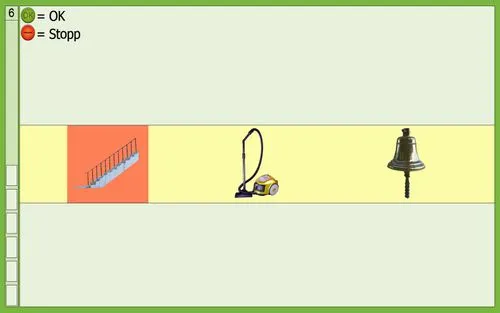
Pictures of specific objects are shown, which the client has to memorise. Subsequently, various objects roll across the screen on a conveyor belt. Whenever an object from the learning phase passes through the marked area, the client should press the „OK“ button.
Training material
There are 9 levels with roughly 200 photos of specific objects. The number of specified objects in the learning phase corresponds to the level. An easy-to-read, large font was chosen for the additional modules with word recognition. The words or images move across the screen continuously and smoothly. The speed can be adjusted.
Languages
German, English, French, Spanish, Portuguese, Italian, Greek, Swedish, Finnish, Danish, Dutch, Belgian (Dutch), Russian, Polish, Czech, Slovenian, Hungarian, Latvian, Lithuanian, Chinese, Traditional Chinese, Korean, Turkish, Arabic, Hebrew, Farsi
Level
9
Topological Memory (MEMO)
Indications
The indications for this training are all for verbal and non-verbal content memory disorders and impairments. Amnetsic syndromes and memory deficits occur with diffuse organic brain diseases, with certain lesions of the limbic loop, vascular diseases, TBI, brain tumours (prefrontal, temporal, parietal), manifest depression and intoxication.
Task
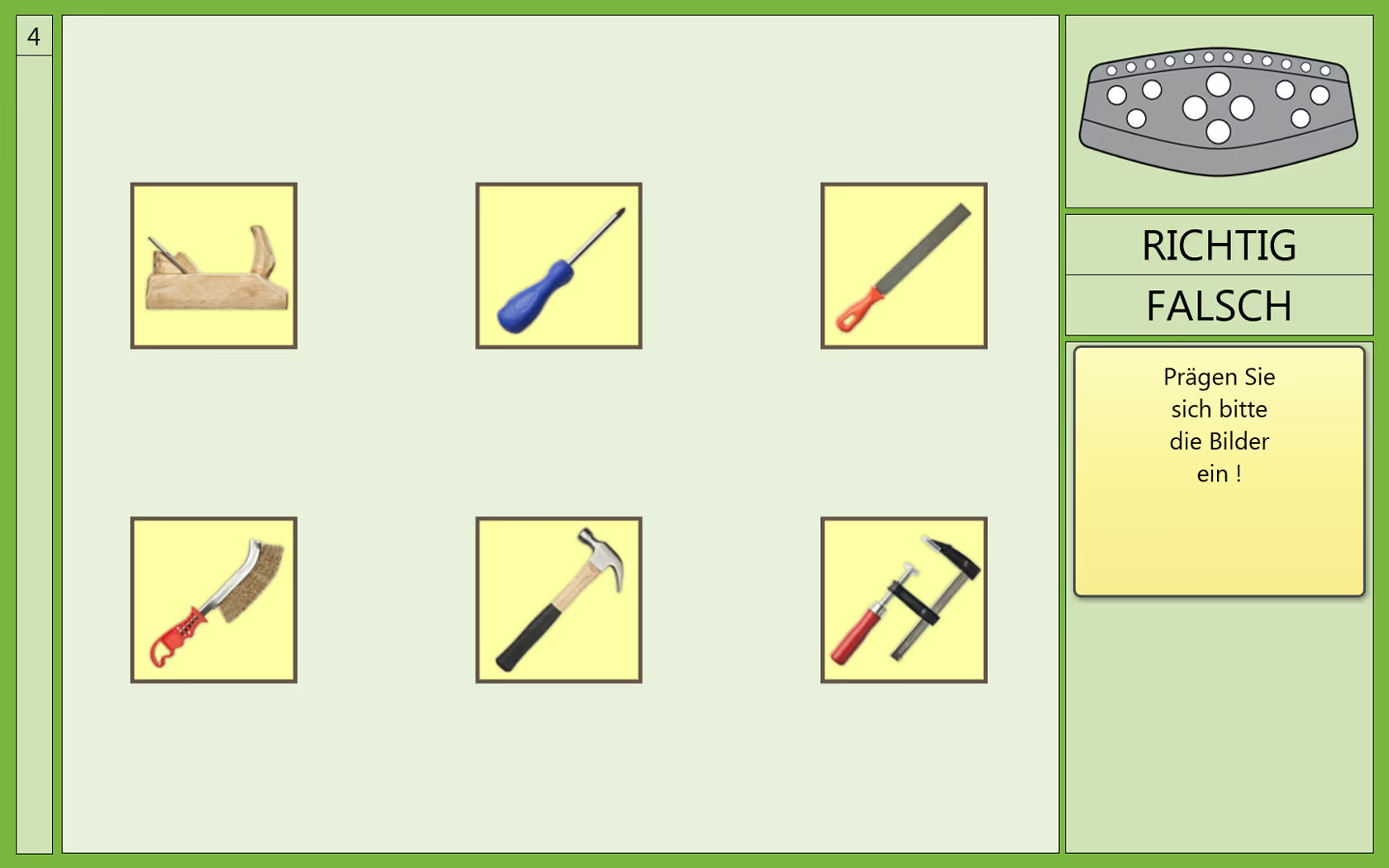
Images are presented on the screen. The clients have to remember where they see the pictures. After a preset time has elapsed or after pressing the OK button, the images are hidden and the clients are asked to indicate under which card the image they are looking for is located.
Training material
20 levels and up to 464 images of specific objects, geometric figures and letters are available. The number of cards offered at the same time varies from 3 to maximum of 16. The difficulty level increases through increasingly complex objects and an increase in the number of cards.
Languages
German, English, French, Spanish, Portuguese, Italian, Greek, Swedish, Finnish, Danish, Dutch, Belgian (Dutch), Russian, Polish, Czech, Slovenian, Hungarian, Latvian, Lithuanian, Chinese, Traditional Chinese, Korean, Turkish, Arabic, Hebrew, Farsi
Level
20