Logical Reasoning (LODE)
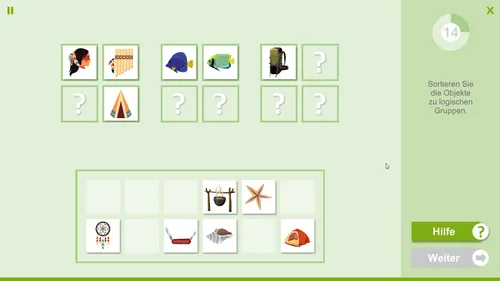
The training aims to improve reasoning skills. The clients have to continue rows of symbols that are built up according to logical rules or sort pictures according to categories.
Indications
Clients with deficits in problem analysis or logical reasoning. This type of loss of performance often occurs with clients who have suffered damage to their frontal lobe after TBI but also those who suffer from schizophrenia or chronic alcohol abuse.
Task
There are two types of tasks. The client‘s task is to analyse and continue the logical series (symbols or numbers). In the task type category, the clients have to find out to which categories (e.g. cars, plants) the displayed pictures belong and then sort them according to the categories.
Training material
In this module, patients work with pictorial representations of objects, numbers or geometric shapes. With increasing difficulty, more and more abstraction levels (including colour, size, shape, order, rotation) have to be considered for the solutions in order to continue the series logically. The categories become more complex in terms of content as the level increases.
Languages
German, English, French, Spanish, Portuguese, Italian, Greek, Swedish, Finnish, Danish, Dutch, Belgian (Dutch), Russian, Polish, Czech, Slovenian, Hungarian, Latvian, Lithuanian, Chinese, Traditional Chinese, Korean, Turkish, Arabic, Hebrew, Farsi
Level
24
Plan a Vecation (PLAN)
Indications
Clients who have problems with prioritising tasks and planning their daily routine. Due to the complexity of the module, there are also requirements for working memory and action monitoring. The ability to plan actions and organise tasks is one of the most complex human abilities. This can be impaired by acquired brain damage and mental disorders.
Task
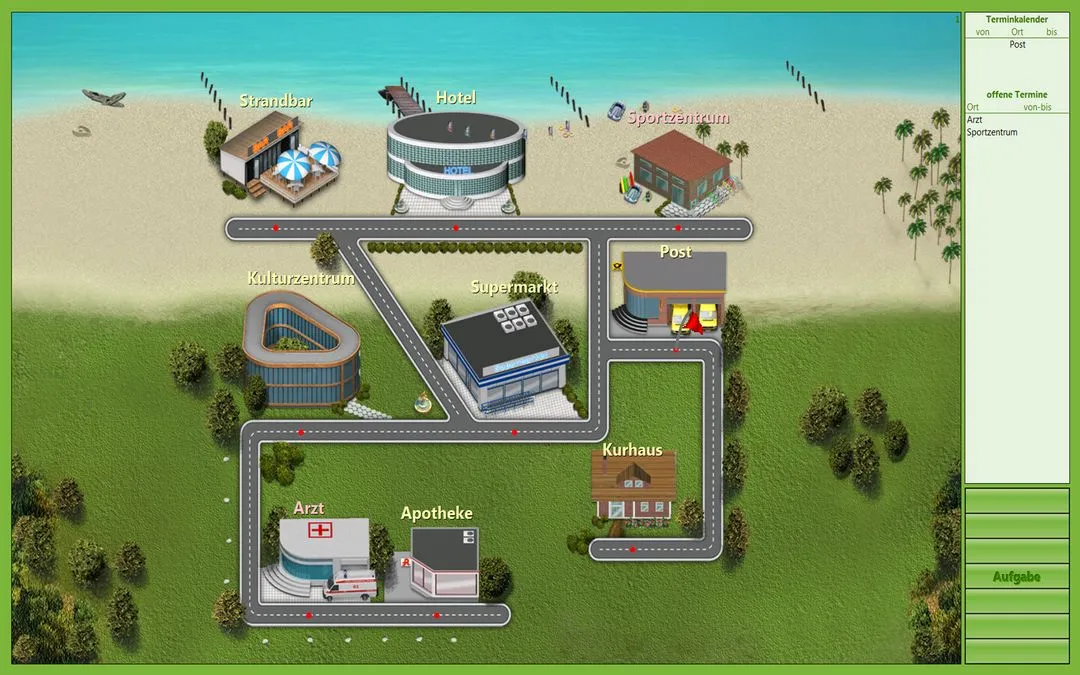
The first part of the task consists of prioritising appointments. In doing so, the clients need to either • find out which appointments are most important • minimise travel times • select appointments so that as many appointments as possible can be completed
Training material
The module offers 55 levels with different appointment combinations. The task is presented via text. These vary from simple, short sentences at lower levels to complicated entences. The difficulty in prioritising and planning is also increased by the number of appointments to be chosen and by the conspicuousness of information on the importance of the appointments. A clear overview map of the fictitious holiday resort supports the chronological structuring of appointments.
Languages
German, English, French, Spanish, Portuguese, Italian, Swedish, Finnish (partial), Danish, Dutch (partial), Belgian Dutch, Russian, Polish, Czech, Slovenian, Hungarian (partial), Latvian, Lithuanian, Chinese, Traditional Chinese (partial), Korean, Turkish (partial), Arabic, Hebrew
Level
55
Shopping (EINK)
Indications
Clients with deficits in working memory, planning and structuring the implementation of actions, concept formation, as well as problems with memory retention.
Task
A shopping list contains items to be found in a supermarket or DIY store and placed in the shopping basket. Once all items are in the basket, the supermarket is exited via the checkout. At higher levels, additional requirements are placed on computational skills. An amount of money is specified and the client has to check whether the amount is sufficient for the purchase.
Training material
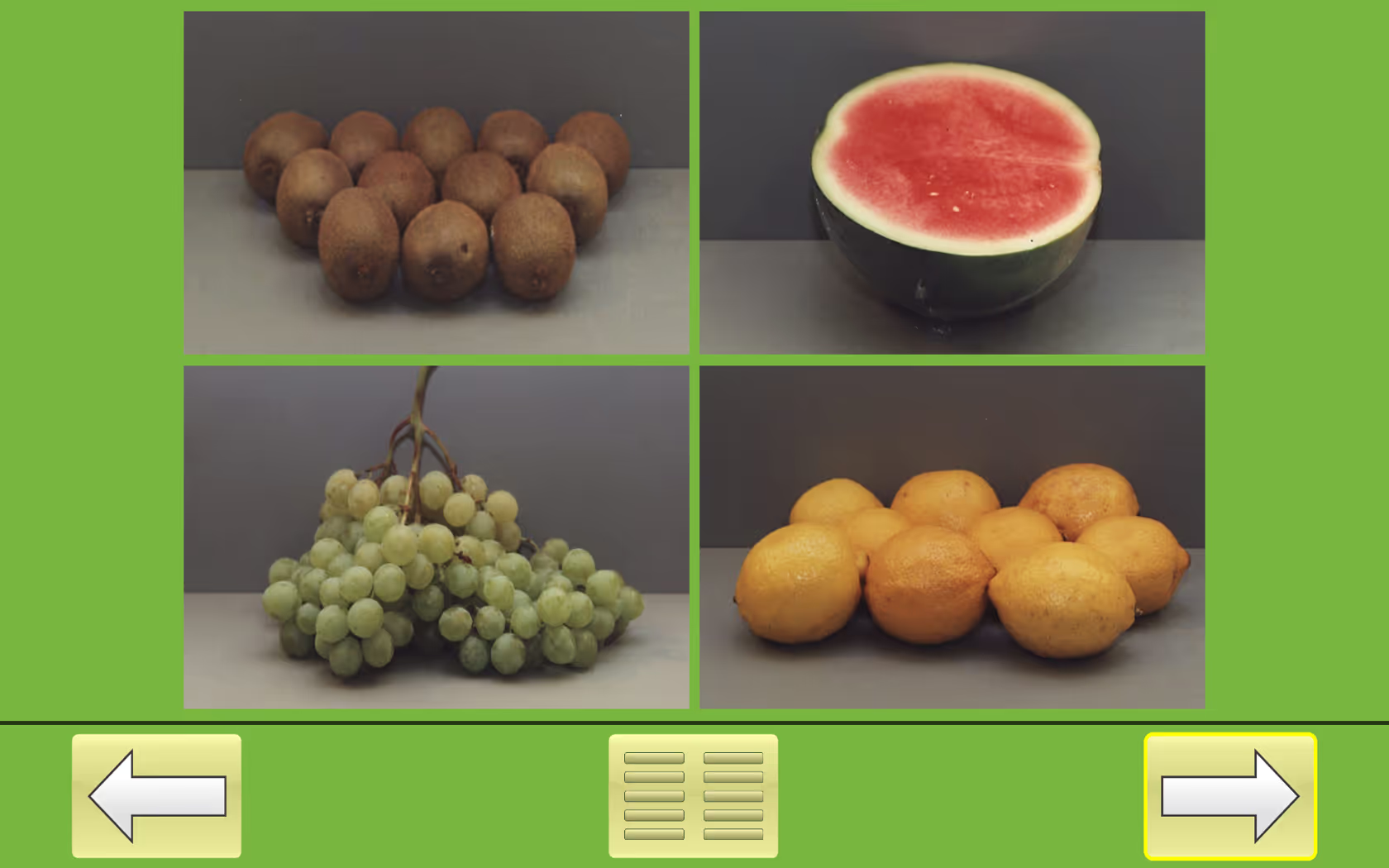
More than 200 photo-realistically illustrated items (e.g. groceries, household items and much more). These items appear on shelves from which they can be selected. The module has a voice output, which means that all items are named when they are selected. There are 18 levels and 2 stages: First, only items according to the shopping list are purchased. Difficulty increases with the number of items to be purchased. On the second level, prices must also be added and compared with the amount of money available.
Languages
German, English, French, Spanish, Portuguese, Italian, Greek, Swedish (partially), Finnish, Danish, Dutch, Belgian (Dutch) (partial), Russian, Polish, Czech (partial), Slovenian (partial), Hungarian (partial), Latvian (partial), Lithuanian (partial), Chinese, Traditional Chinese, Korean, Turkish, Arabic (partial), Hebrew, Farsi (partial)
Level
18
Calculations (CALC)
Indications
Impairments in arithmetic cognitive abilities. They range from disorders in estimating sizes and quantities to problems with carrying out basic calculations to difficulties in solving complex mathematical problems.
Task
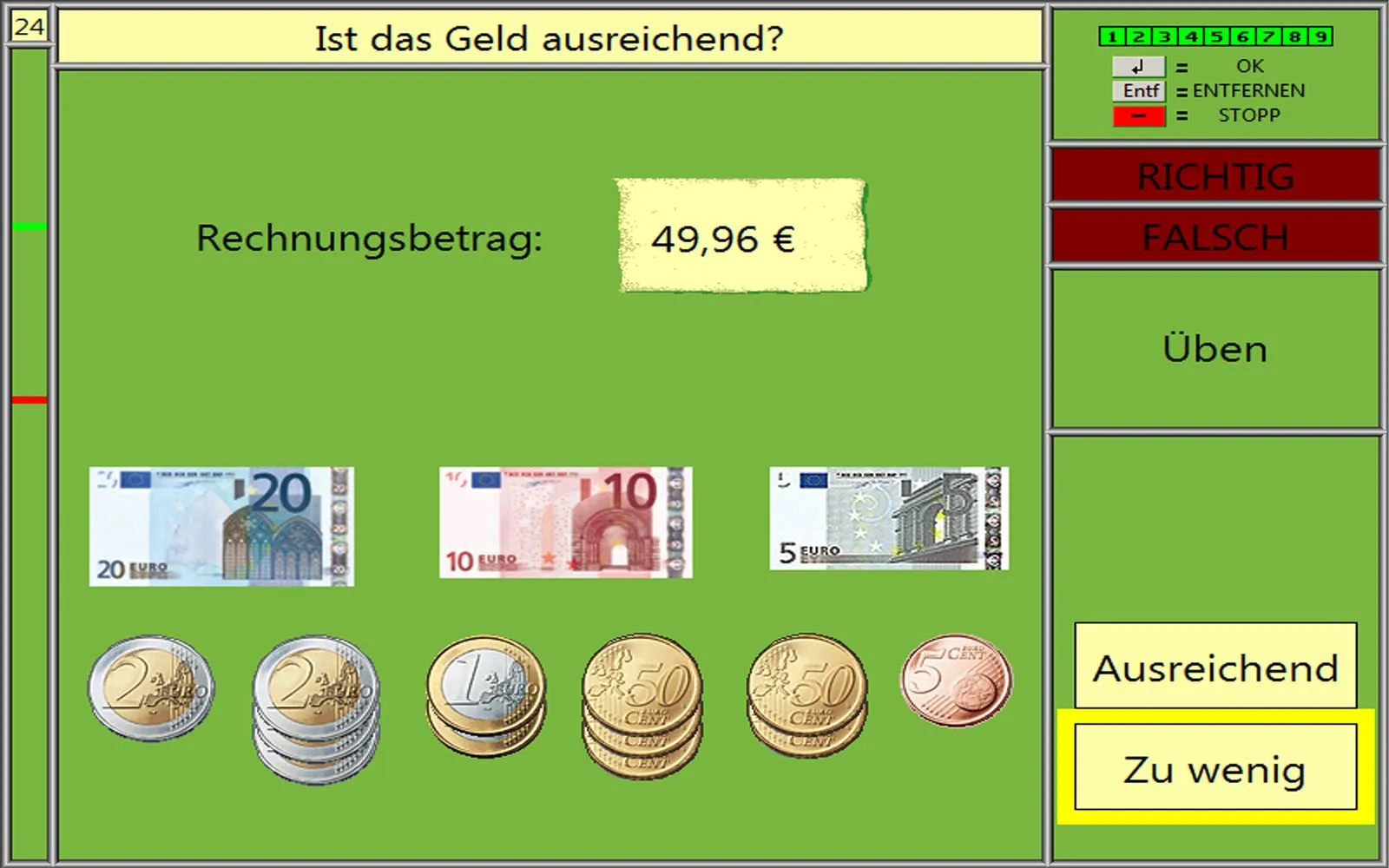
The module offers a wide range of tasks. It starts with simple size and quantity comparisons and sorting tasks. The basic calculation methods for addition and subtraction are then practised both mentally and in writing. In higher levels of difficulty, the clients train very realistically how to deal with money. Among other things, the clients have to pay correctly, give money back or check the money they have received. Finally, multiplication and division tasks are available.
Training material
Size and quantity problems are practiced with pictures of simple objects before moving on to calculating with numbers. Written adding and subtracting is illustrated with small digits in the carryover. The handling of money is practised with images of real banknotes and coins. The module has 42 difficulty levels and works adaptively.
Languages
German, English, French, Spanish, Portuguese, Italian, Greek, Swedish, Danish, Dutch, Belgian Dutch, Russian
Level
42